
Why TV's decline matters for radio
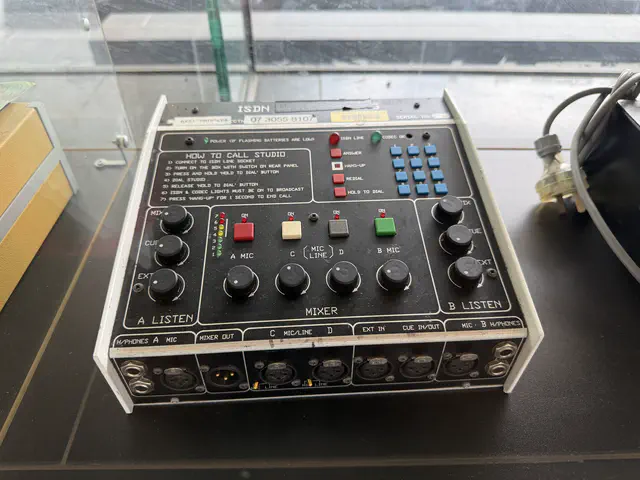
Above: a Glensound ISDN unit, in the “museum” in the ABC’s Brisbane headquarters. As ever, nothing better than seeing equipment you used day-to-day (or, in this case, saw being used) in a museum.
I’ve been watching the troubles of the television industry, in a detached sort of way. It’s really very clear how quickly the business of live television is collapsing before our eyes, and it seems every few weeks there’s another story about cost-cutting within the TV industry. (I can’t really remember the last time I watched live television from the antenna. Actually, I can - we turned on the TV on Jan 24 to listen to Triple J’s Hottest 100. But that wasn’t “watching the television”).
Particularly from an infrastructure point of view, the end of broadcast TV is moving really very quickly. In the UK, there’s increasing talk about switching off terrestrial television broadcasting. 2034 is given as a potential switchoff date, given that’s when the contracts are due for renewal with broadcasting infrastructure company Arqiva.
But, that’s television, and so we don’t need to care about it. So I thought.
But, what I’d not appreciated until now was that of course this means that the costs for maintaining the terrestrial transmitter network post-2034 would be no longer mostly paid-for by television. That means that radio could end up being charged significantly more, according to a story in The i Paper. Radio isn’t always co-sited with TV, but clearly, maintenance of masts, ground rent, the cost of staff and offices, and many other parts of the broadcast infrastructure would end up having to be paid-for almost entirely by radio broadcasters. And, frankly, there isn’t the money to go round there.
Much to think about there; while FM and DAB+ don’t require anywhere near the same kind of infrastructure as AM or TV, at high transmission powers they still do require proper transmission.
Meanwhile, the UK government is running a review about the future of FM radio “beyond 2030”. DAB is still much, much bigger than online, so no suggestion right now that it’s the end of terrestrial radio; and those masts will still be required.
RadioToday report a Europe-wide piece of work on Friday, “celebrating listening to radio in the car.” I’m still surprised at the piecemeal approach that the radio industry is taking towards car manufacturers, which means we get this sort of bad experience, because nobody is apparently talking to auto manufacturers about how to make it better. (Not helped by commercial radio in Australia over-filling its multiplexes, which has broken much of the functionality of DAB in my car - something nobody cares about either).
The BBC has launched a new tech podcast called The Interface - “a BBC Studios Audio production for BBC Sounds in the UK and BBC.com internationally” - and, true to form, it has a bewildering distribution plan. If you’re in the UK, you can listen to it on BBC Sounds, or wherever you get your BBC podcasts. Outside the UK, you can listen to it on BBC.com, or wherever you get your podcasts… or watch it on YouTube.
- So - outside the UK, despite the BBC’s website having full video capability, you’re not watching it there. No - you get to watch it only on a US website, Google’s YouTube, with advertising and/or tracking. And - inside the UK, despite the BBC’s website having full video capability, and the BBC having this thing called the iPlayer that has lots of longform video content, you don’t get to watch this thing at all - it’s just audio for you.

Classifieds
- Supercharge your radio show with world-class prep: the right show prep delivered to you on time, EVERY day, without fail. Grab a £1 week-long trial of Show Prep and stop chasing round looking for things to use on your show, running out of time before the show, and trying to sight-read the newspapers!
Discovered for Podnews, but in radio, we’ll find this helpful too - you probably know that FFMPEG is great for audio encoding and conversion, but you might not know that it can also sort out LUFS levels, add compression and EQ, and a bunch of additional things. FFAB is a really nice UI for the tool, and gives you the command line for what it’s doing, so you can add the commands to your workflow. Genuinely amazing what FFMPEG is capable of doing, it turns out; and this UI lets you play with the buttons to your heart’s content. Very nice.
Doing a websearch for Phil Riley (trying to remember where I’d read the main story), I notice that he blogged at the end of last year about the funding debate for the BBC, and its effect on radio. Privatising bits of the BBC would be a calamity for everyone, he argues.
Random radio research corner:
- Here’s 2025’s radio figures for Finland. Radio reaches 83% of the population a week. Daily listening is 2 hours 4 minutes (just 32 minutes for those aged 9-24 though). There’s some nice data about where they listen, and who to - a very clear, inclusive report.
- Here’s the S3/25 survey for New Zealand. Unlike the above, it’s just two sets of tables; a tiny cramped graphic at the bottom of page 1, and the figures don’t include RNZ, the public service broadcaster (or many of the community stations). Radio is much stronger in Aotearoa than these figures would tell you.
I’m on ABC television tonight in WA during their 7pm news, talking about ABC Radio Perth’s switch later this month over to 102.5 FM. Hopefully it’ll be almost as good as this very nicely written piece from the ABC on its website, which correctly catches all my tedious caveats about AM still being important for long-distance, etc. Tomorrow morning I’m on ABC Radio Perth.
- I didn’t hear from Peter in Waverley, but did hear from another former ABC employee called Ed, who sent me a grumpy email saying I do “carry on so much about AM”, adding “I’m just interested in the content, and couldn’t really care less about the form of modulation.” I replied that I’m interested in people actually listening to the content.
I spoke last week at The Radio Festival in New Delhi (I think). You can watch many of the sessions on this website (and you can turn YouTube’s captions on to translate). There was a session called “Is radio dying or thriving”, where some radio people argued that radio was, er, dying, which was a brave career move!
Thank you to RadioToday in the UK for becoming my latest supporter. As long as I’ve been in radio, RadioToday has been there, covering the changes in the industry. It’s an excellent resource, and I’m excited to see some of Mr Roy’s money! I shall spend it wisely.
Where I am speaking next
- Radiodays Europe, Riga, Latvia, (Mar 22-24) The future of audio is people-powered: The way people consume media is changing. James Cridland, the radio futurologist, takes a look at global trends in radio and on-demand. How will we listen - on which devices? How can we make our output truly unique? How do we do it in a resource-efficient way? And what part does video play in the future of audio? In this wide-ranging session, bringing together data from North America, Asia, Australia and Europe, we’ll learn why the future is bright - as long as we understand why our audience comes to us in the first place.
- The Podcast Show, London UK (May 20-21) - I’ll be keynoting at this event, as well as recording a Podnews Weekly Review.
Supporters
Thank you to the supporters below, plus Gavin Watson, Greg Strassell, Sam Phelps, Richard Hilton, Emma Gibbs, Jocelyn Abbey and James Masterton for being regular supporters.
If you’d like to support my work in any way, you can BuyMeACoffee - become a member to give regularly or just give a one-off coffee, or five. Here’s where to do that. Or, alternately, here’s a way direct with Stripe.
I’m on Mastodon as @james@bne.social
My website has more detail about who I am, and what I do, and whether I can help you further.
My newsletter is supported by:
Selected bits from Radioland are in RadioInfo in Australia, and RAIN News in the US
Lesen Sie außerdem ausgewählte Artikel auf Deutsch in Radioszene