
Radio in car: shock new figures
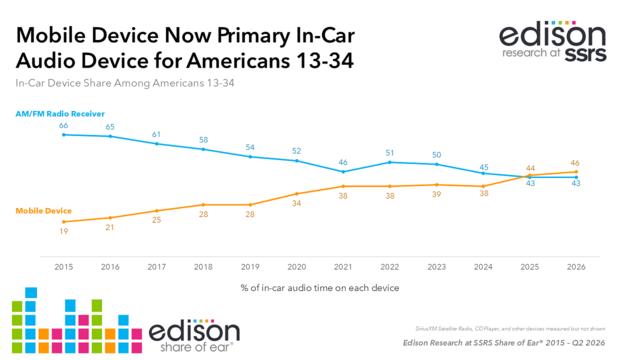
Above: radio has always been the #1 choice in a car. Until now. This data, from Edison Research’s Share of Ear study, has shocked me. It shows, very clearly, that for young Americans, they’re choosing to listen to media from their mobile phone instead.
I don’t know why it’s shocked me. I myself rarely listen to radio in the car. My iPhone connects via wifi to the car dashboard, so I have my collection of podcasts to listen to, as well as music on Spotify. In many cases, why listen to the radio, when I have everything I need on my phone?
Now, sometimes, sure, I’m listening to live radio on my phone, via the car’s dashboard. I’ve discovered that BBC Radio 1’s early morning show is quite a good listen for school pick-up time, for example. But that’s the exception, rather than the norm.
This is quite the watershed moment. It shows, clearly, that radio has become, for younger Americans at least, less relevant than audio from their own mobile phones. Part of that is that much of US radio really isn’t very good (sorry, but it’s true); but it’s a concern nonetheless.
I suspect most people will look at this, shrug, and move on. But I find this the most worrying graph I’ve ever seen about radio’s future.

Classifieds
- Supercharge your radio show with world-class prep: the right show prep delivered to you on time, EVERY day, without fail. Grab a £1 week-long trial of Show Prep and stop chasing round looking for things to use on your show, running out of time before the show, and trying to sight-read the newspapers!
Meanwhile, in Europe, Radioplayer has launched “real-time car radio analytics”, delivering a real-time view of listening across DAB, FM and streaming. They’re not alone in this - DTS AutoStage also provides similar to the US market. I’m unaware how much DTS AutoStage deals with DAB or with online radio. But, Radioplayer is present in many markets in Europe, and has some good relationships with auto manufacturers.
Some very interesting moves from Global in the UK, which has launched Radio Plus - “The same great live radio. Just without the ads”. The “just without the ads” promise is only for music radio, where additional music is played instead of the ad breaks. It costs £4.99 (US $6.50) per month per brand (Heart, X, Smooth, etc). Its competitor Bauer has been offering something similar for many years; it will be interesting to see the takeup of this service. Do listeners hate the ads enough to spend money to get rid of them?
By law, Italian radio broadcasters have had access to DAB+ for free, until DAB+ coverage is complete enough, and until enough people own DAB+ radios. But, an Italian radio association claims that DAB+ coverage still isn’t good enough - and there still aren’t enough receivers out there - so could they please continue not paying any fees for the next five years? I must admit, I don’t quite understand who does pay in this example, but it’s probably not entirely a surprise that radio broadcasters would like to avoid paying additional fees if they can avoid it.
Kyle Sandilands is to speak at Radiodays Europe next year. I don’t need to explain who Kyle is to you, right? Good. Kyle will be speaking on Monday 15 March. The week before, 7 March, he’ll be allowed back onto FM radio in Australia under the terms of his contract; I wonder whether he’ll be bored of his online radio station by then? Quite the coup for Radiodays to get King Kyle speaking in Palma.
A new report from Midia Research claims that Gen Z and younger Millennials are turning to radio for music discovery. The report suggests that “42% of live radio listeners aged 20-34 tune in for music discovery, highlighting the demand for human curation”. Another data point: “Among average live radio listeners, being free is the format’s biggest strength, cited by 50%, followed by news, weather and travel updates at 36%, and music discovery at 32%.”
I Was on a Plane the Morning of 9/11 wrote Steven Goldstein earlier this month. It’s a clear argument for human connection and shared experience on the radio - and the benefit of breaking format when your audience wants you to.
The way that radio is measured in Canada has significantly changed. Numeris has started using Radio Local+, a new hybrid radio measurement approach. It combines streaming data with people-based research - in a similar method, if I understand it, to Australia and the UK - to offer more consistent statistics to more markets in Canada (and a shift to quarterly numbers, too). For more, I recommend two podcast episodes: Matt Cundill’s Sound Off Podcast and Broadcast Dialogue’s podcast.
You might have guessed that I’ve been quite busy recently. Sorry for the lack of newsletters. More to come. But, if you like them, here’s a trip report of my flight from Brisbane to New York.
Where I am speaking next
- Audio Academy Festival, London (Oct 1)
- Community Media Festival, London (Oct 3)
- Radiodays Europe, Palma, Mallorca (Mar 14-16)
- Somewhere exciting, early June, USA
- Somewhere exciting, early August, USA
- Radiodays Asia, late August, Taiwan
Supporters
Thank you to the supporters below, plus Dafydd Furnham, Marty from New Yawk, Gavin Watson, Greg Strassell, Sam Phelps, Richard Hilton, Emma Gibbs, Jocelyn Abbey and James Masterton for being regular supporters.
If you’d like to support my work in any way, you can BuyMeACoffee - become a member to give regularly or just give a one-off coffee, or five. Here’s where to do that.
There’s a podcast version of this newsletter if you prefer that. I’m on Mastodon as @james@bne.social if you’re there too. And my website has more detail about who I am, and what I do, and whether I can help you further.
My newsletter is supported by:
Selected bits from Radioland are in RadioInfo in Australia, and RAIN News in the US
Lesen Sie außerdem ausgewählte Artikel auf Deutsch in Radioszene