
Long term review: MG's MG4 Essence 64 EV

I’ve had an MG4 for almost a year, so I guess it’s probably time for a full review of it. So here is that review.
First, the name. The proper name of the car is an MG4 Essence 64, and its brand is MG, so technically I’m driving an MG MG4 Essence 64, which seems a rather repetitive name. But there we are.
We needed a second car for the school run, so the thought was that this would be a smaller occasional-use car and not the main family car. I bought it because it was the cheapest electric car on the market in Australia at the time. The on the road price was AUD $44,990 (that’s £22,380). I bought an electric car because there was a tax benefit to my company buying an electric car (this is technically a company car), and also because I wanted an electric car. I’d not done much research other than understand how charging worked and watched a few YouTube videos of reviews of the car (almost everyone liked it). I’d been in one that was being used as an Uber, and the driver seemed to like it.
MG is a British brand, but these days, MG is owned by SAIC Motor. The “S” used to stand for “Shanghai”, and it’s a state-owned Chinese motor company. It’s apparently China’s largest motor company. It’s the third-largest electric car maker in the world, and the second-largest car battery maker in the world. They probably know what they’re doing.
So, what’s it like?
I went for the Essence 64 model, which was a little more expensive than the cheapest one. It included things like wireless phone charging, a built-in GPS system, 360-degree cameras and things, and wasn’t much more expensive than the base system. The 64 relates to the battery capacity.
There are two screens in the car - one for the speedometer and the car display, which is behind the steering wheel. The other is for the in car entertainment and controls - a larger touchscreen thing that appears to run a fork of Android as an OS.
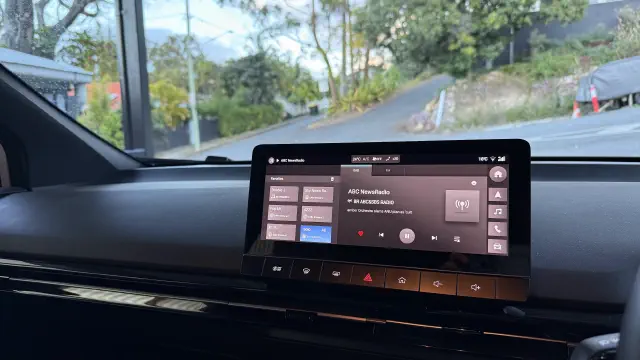
Initially, the software really isn’t great, and takes getting used to. The radio isn’t very intuitive to use and coded by someone who has never listened to the radio; the GPS satnav is a weird thing that looks like very similar to Google Maps but is using a map downloaded to the car and bleeps every time you enter a new suburb. The myriad of settings screens don’t seem to keep their driving settings between drives, but apparently that’s by design - there has to be a default setting which the car will always go to because the law says that. As ever, the processor is a little underpowered for what it’s being asked to do. The UX is bad and inconsistent all the way through and I was a bit grumpy at it, at the beginning.
But you soon understand how to use it, and how to get past the oddness of the system. At the beginning, idiots like me will try every part of the system to fiddle with settings, but very quickly you get things set how you want it, and then the software really fades away, since most of the time it’s likely that you’ll use Apple CarPlay or Android Auto on this thing anyway.
Just like the software, there are plenty of other things about the car that take a bit of getting used to. It’s the cheapest electric car for a reason, and so long as you remember that, you can probably forgive it for many things.
You can forgive it for having automatic headlights but no automatic windscreen wipers. The wireless charging for the phone is a nice gimmick but lacks any MagSafe thing - which means your phone is then charging on a shelf, in a car, and will fall off every single time you turn a corner. And what’s the point of a wireless charging pad when the car doesn’t support wireless Apple CarPlay? More than likely, you have to have it plugged in anyway, but that’s forgivable really.
The fact that the indicator stalk is the other side of the steering wheel from the Toyota Prius is annoying. Not sure who to blame for that, though.
One thing that niggles me a little - the car has a 4G SIM inside it, so it’s always connected - I gather this is a safety requirement for cars these days. (You can also connect it to your home wifi for when it’s in the garage). This allows you to have an app to control certain things; and allows it to keep updated in terms of traffic information and weather. It has 360-degree cameras right round the car, which are very helpful when parking in tight spots. It has a voice-activated assistant - “MG, listen to the radio” - inside the car. So, it’s capable of collecting images of every piece of road I travel on, knows when, where and how fast I drive, and can listen 24x7 to what I say inside the car, and can transmit this data, live, back to the car manufacturer, a company that is owned by the Chinese state government. I’d suspect that law enforcement could get access to that data too. I don’t really have particular concerns, but if you’re a drug dealer or plotting the overthrow of President Xi, this car is probably not for you.
What’s it like to drive?
Like any electric car, push your foot to the floor and it gives very good acceleration indeed. In fact, the difficulty I had was being gentle with the acceleration, having come from a Toyota Prius which was not the most powerful thing in the world.
It’s rear-wheel drive, which makes steering very light indeed, and capable of very tight turning circles. That makes it fun to drive - particularly fun to take on a winding road. The car is low to the road (it’s not that easy to get in an out of as a consequence), but that heightens the enjoyment of a drive in the thing.
The default setting (and one that resets every time you use it) is for it to slow down quite a lot when you take your foot off the accelerator. This is most unlike a petrol car, and so you need to get used to how it feels. As you take your foot off the pedal, the car is essentially breaking using the motor, generating energy which it’s putting back into the battery.
It has adaptive cruise control (so it’ll keep up with the car in front if you want it to). The cruise control works all the way down to zero, so you can use it in very heavy traffic to just crawl along with other cars. It’s great when it works, which is almost all the time. Occasionally it gets confused, and can brake quite suddenly if it thinks you’re driving into a parked car.
Over 60 km/h, it has lane assist (which will bleep at you in an annoyed fashion if you don’t stay within your lane, occasionally tugging at the wheel), and if you want to, you can also set it to turn the steering wheel for you (though you still have to keep your hands on the wheel). Lane assist works quite well, except when it doesn’t - it can get confused at some road markings, and I’ve got used to one patch near the airport where it always wants to violently pull the car to the left at one point.
One great thing is an automatic handbrake (you need to turn this setting on, but once it’s turned on, it’s permanent thankfully). Stopping for a red light? Once you’ve come to a halt, push your brake pedal a little further, and the handbrake turns on (with an indication on the dashboard). Then you can release the footbrake entirely and the car won’t move - it takes the handbrake off as soon as you push the accelerator again. This is brilliant. I assume more cars have it but it’s a first for me.
It’s also blissfully quiet. The only noise is the air conditioning, and the sound of the tyres on the road (which it turns out is the main noise of many cars actually). Quiet suburban driving is very quiet indeed.
How has the electric bit been?
This was supposed to be the “second car”, and therefore I felt it would be doing trips to the shops or to school, and that would be it. School is 15 minutes away. The shops are similar. The range of the car is 435km; the trips I’m regularly doing are 10km. I’ve had absolutely no “range anxiety”.
I’ve used it for longer journeys, of course. The range has never been an issue even then. There are a few apps you can use to see all charging points near you, if you need that. I’ve paid to charge up only three times in the past year - once because, frankly, I wanted to learn how to do it (I’d have made it home with plenty to spare); another time because we had no power at home and I wanted to make sure that the car was full.
Charging points are like petrol stations: there are a confusing set of different brands operating them and each have their own app. Google Maps has lots of information though - search for “car charger” and you’ll see all the chargers near you and whether they’re being used. The MG uses the same plug that most others use. When I used one to charge from about 30% up to 80%, that cost AUD $31 (for 42kWh) and took 32 minutes to charge, which was a nice relaxed coffee in the adjacent shopping centre.
Normally, I charge the car up to 80% full (best for the battery apparently). I drive it. When it gets below 70%, which is normally a few days using it, then next time I use the car, I’ll finish the drive by plugging it in, at home. I’ve set it to charge overnight when electricity is cheap, but also set it to charge during the day if the sun is shining and thanks to the solar, we have more electricity than we are using. The charger is in the garage and just plugged into a main electricity socket - it charges quite slowly, a couple of percentage points per hour, but that’s all you need really. A charge overnight might give it 15% or something.
I could speed that up by buying a home charger. The thing that plugs into the mains charges at 1.3kWh. I could buy a thing that charges at double that. I could even upgrade the wiring in the house and get something to charge at triple that. But I haven’t done that. In normal use, 1.3kW is fine. It’s easily able to be powered directly from the home solar panels, so essentially charges free. I don’t drive enough to make faster charging a requirement. In most cases, just plug it in when you get back from a journey, and it’ll slowly fill up.
And of course, I’ve interfaced my Home Assistant smart home controller with the car, so I can tell it to only charge when the electricity is cheap, or only charge when it is free, or only charge when there is enough sun. That means that for most days, it can charge for only about 12 hours rather than the full 24. That’s made no difference really: it’s almost always full.
The byproduct of all this is that the car is essentially free to use, since I’m not paying for fuel, and most times it’s only charging on free electricity.
And the byproduct of that is - it’s free to use, and it doesn’t make any emissions, so I feel absolutely no guilt to jump in the car to go to the coffee shop that is a 15 minute walk away, rather than to walk. There’s virtually no environmental impact at all.
And the byproduct of… all that… is that this has quickly become the main car for the household. The Prius is bigger, and a bit more comfortable, but it’s loud and it costs money. Why use it when we can drive for free?