
Kyle & Jackie O - what their show ending means for the industry
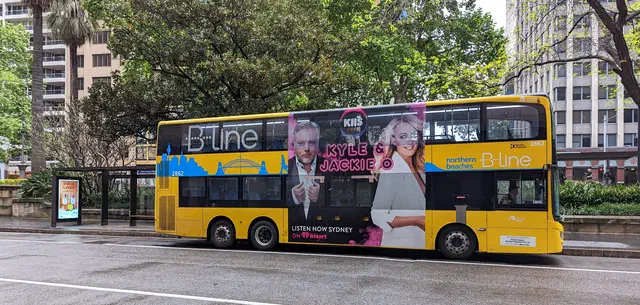
One of Australia’s biggest radio shows, Kyle & Jackie O, has ended. Tuesday’s announcement to the ASX, the Australian stock market, makes it clear that it isn’t a stunt. The show is now off the air: Kent Small is doing the breakfast show in both Sydney and Melbourne (this is Australian radio, so he has to have a nickname, which is “Smallzy”).
Employment lawyers will now be involved, in two of the biggest media legal cases in the country, as things begin to get messy. Jackie “O” Henderson is now saying that she “did not quit or resign”, in a statement that, perhaps pointedly, didn’t mention Kyle’s name once. Kyle (who has also taken time away from TV duties) is also reported to be priming his lawyers for a reported $88mn; potentially arguing that a similar argument on-air last year wasn’t treated as serious by ARN, his whole show was based on controversy, and a slightly misguided view that ARN’s censors should have prevented the argument going out. There’s plenty more informed coverage in the Game Changers Radio podcast.
This might look like a peculiarly Australian news story. But, actually, I think it raises questions for radio people everywhere. Here are some of them.
1: K&J were on a massive pay packet - reported to be $200mn (£104mn) for ten years, and described by one radio executive as “insanity”. That was signed at the top of the commercial radio wave a few years ago; the industry has since seen a decline in revenue, and this contract seems entirely unrealistic now. You’d suspect that ARN are pleased to have an excuse to terminate the show. To sign up for a ten-year contract, in this media environment, seems careless. How long are your contracts?
2: That guaranteed income for K&J probably made them lazy and disinterested in staying at the top of their game. There is considerable precedent for this in the UK - Chris Evans, both on BBC Radio 1 and again on the original Virgin Radio, clearly went through a period of laziness and disinterest, which cost him his job on both stations. Most creative people need to feel challenged to get the most out of them; so by offering them so much money ($50,000 per show!) it also meant they were less hungry to perform well. They earned so much money, they just needed to turn up, not to be successful. How do you pay your creative people?
3: It’s also reported that the $200mn contract gave all creative control to Kyle; so ARN were unable to control the content of the show. Again, this is similar to Chris Evans, who - as detailed in the Breaking Breakfast podcast - insisted that he was in charge of the content of his show. A radio licence-holder needs control of its output. (ARN put two “censors” on the show, ostensibly to stop anything bad going out, but quite what you can do with a thirty-second delay is anyone’s guess). Who is in control?
4: At the same time as Jackie Henderson signed her $200mn contract, she also started doing her own podcast, called Her Best Life, co-hosted by her talent manager since 2022, Gemma O’Neill, as part of a new venture called Besties. (She left that in January). It’s naïve to claim that these shows were competing for audience, as I’ve heard some say this week: but the new project was certainly competing for Jackie and Gemma’s attention. When does a side project derail the main job?
5: The ACMA, Australia’s media regulator, is relatively toothless in what it can do. It’s spent the last year investigating the output from K&J but still hasn’t actually issued any licence changes or fines, in spite of hearing from ARN more than three months ago. In my view, there is a question over whether the ACMA is doing its legal duty under broadcast law. I have a Freedom of Information request for ARN’s representation, which you’d assume would be public. What is ACMA doing? And who should resign?
6: The Mad Fudging Witches (not their real name) have been campaigning for a long while against advertisers who fund the show, in a campaign called #VileKyle. Their website lists 48 advertisers who they say they’ve successfully convinced to stop advertising in the show; there is no doubt that this has hurt ARN’s revenue. This group has been dismissed by many in the industry - but it shouldn’t be. People power matters. How brand-safe is your programming?
7: K&J started simulcasting the Sydney show into Melbourne last year. Making the show national was the only real way that ARN could ever hope to recoup some of the costs. But, this has been an abject failure. Some industry pundits will tell you that it shows that radio needs to be local to succeed. Others will tell you that it was just a bad show, and audiences in Melbourne were not familiar with the type of peurile programming that K&J have put out for years. I think it was the latter. How important is “local”?
8: The biggest radio star that ARN now has is - with all due respect to Kent Small - the breakfast host for Gold, Christian O’Connell. He is doing a breakfast show in Melbourne and now in Sydney, Brisbane, Adelaide and Perth. He’s the #1 in Melbourne, and the exact opposite of the crassness and lewd output from Kyle: a warm, professional presenter with a strong work ethic, and a real hunger to succeed. The first numbers come out on March 19 - survey 1 always being an unusual one in Australia, being six weeks long rather than “the last two surveys mushed together”, as the rest of the year is. Sydney’s numbers will be keenly watched. Will the Brit teach the Aussies a thing or two?
9: What is KIIS, if it isn’t Kyle & Jackie O? Some industry pundits have suggested that the brand is so closely aligned with K&J that it needs an entire reboot. What’s clear is that in most cities, KIIS’s top 40 format is a highly competitive space, with NOVA and SCA’s hit stations also fighting for the audience; while Gold operates in a space that is much easier to own, with many more potential listeners. I’ve long argued that in Brisbane, KIIS should move to digital-only, and 97.3 be used for Gold. ARN would be fools not to. How closely aligned is your station brand to your biggest star: and what happens if they leave?
It’s a fascinating time in Australian radio. But, there again, it’s a fascinating time in radio overall. Worth keeping watch.

Classifieds
- Supercharge your radio show with world-class prep: the right show prep delivered to you on time, EVERY day, without fail. Grab a £1 week-long trial of Show Prep and stop chasing round looking for things to use on your show, running out of time before the show, and trying to sight-read the newspapers!
The BBC appears to have pulled its Google speaker action, or whatever you call these things, making it impossible to listen to BBC World Service. From Australia, “Hey, Google, play BBC World Service” seems now to default to a random American radio station’s overnight feed. It always used to go via a thing branded (on the screen) with BBC Sounds, then a thing just branded “BBC”. It’s fine, it’s not like there’s a new world war or anything.
In the US, one of the largest radio operators Cumulus Media has filed for bankruptcy. The company, which owns the Cumulus Podcast Network and Westwood One, is trying to eliminate around $600mn of debt. It’ll continue operating under chapter 11 protection in the meantime. Competitors iHeartMedia filed for bankruptcy in Mar 2018. Audacy filed for bankruptcy in Jan 2024. Cumulus itself last filed for bankruptcy less than ten years ago, in Nov 2017.
In Podnews, I love writing about the history of podcasting. A 21 year-old industry, with surprisingly little information about the more esoteric part of its history. Very proud of this article about Google Listen, which predated Apple Podcasts by three years as a phone app.
Something I missed in Brisbane, until I was driving past their studios: Christian broadcaster Family 96.5 is now called Rise 96.5.
The BBC responded to a UK government consultation about the renewal of its Royal Charter and how the broadcaster will be funded in coming years. “We will explore opening up BBC Sounds to UK third parties and creators”, the response claims. A brilliant idea: one the BBC trailed before the launch of BBC Sounds in 2018, press-released at launch, promoted again in its 2020/1 Annual Report, and has continued sporadically making piecemeal agreements, like with Goalhanger in Nov 2024. As ever, Radio France shows the way.
Where I am speaking next
- Radiodays Europe, Riga, Latvia, (Mar 22-24) The future of audio is people-powered: The way people consume media is changing. James Cridland, the radio futurologist, takes a look at global trends in radio and on-demand. How will we listen - on which devices? How can we make our output truly unique? How do we do it in a resource-efficient way? And what part does video play in the future of audio? In this wide-ranging session, bringing together data from North America, Asia, Australia and Europe, we’ll learn why the future is bright - as long as we understand why our audience comes to us in the first place.
- I’m also talking with Steve Jones of Stingray, on TuneIn, Canadian radio, and more.
- The Podcast Show, London UK (May 20-21) - I’ll be keynoting at this event, as well as recording a Podnews Weekly Review.
Supporters
Thank you to the supporters below, plus Marty from New Yawk, Gavin Watson, Greg Strassell, Sam Phelps, Richard Hilton, Emma Gibbs, Jocelyn Abbey and James Masterton for being regular supporters.
If you’d like to support my work in any way, you can BuyMeACoffee - become a member to give regularly or just give a one-off coffee, or five. Here’s where to do that. Or, alternately, here’s a way direct with Stripe.
There’s a podcast version of this newsletter if you prefer that. I’m on Mastodon as @james@bne.social if you’re there too. And my website has more detail about who I am, and what I do, and whether I can help you further.
My newsletter is supported by:
Selected bits from Radioland are in RadioInfo in Australia, and RAIN News in the US
Lesen Sie außerdem ausgewählte Artikel auf Deutsch in Radioszene