
BBC Radio 4 Extra closure: but what are the savings?
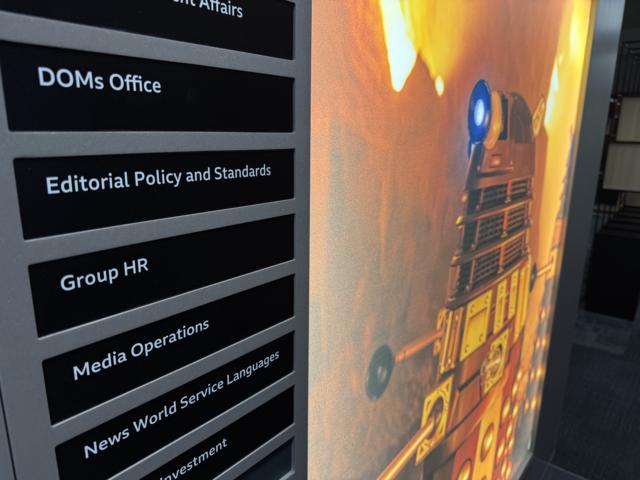
Above: it’s surely no coincidence that the floor in BBC Broadcasting House where the HR department is working out how they can remove hundreds of staff is… currently illustrated by a human-destroying Dalek.
A Radioland reader suggests that the closure of BBC Radio 4 Extra (speech archive) is deliberately calculated to be politically awkward for the UK government, since it is so loved by middle England, and therefore will result in the BBC being spared the worst of the cuts. This is certainly a strategy that the BBC occasionally employs; especially, when a decision is the only thing covered on Feedback.
RAJAR last week showed BBC Radio 4 Extra’s audience as being 1.4 million, with a 1% market share. Radio 4 (news and speech) itself has 8.7 million listeners, a 10.3% market share, and is listened-to almost twice as long, per listener, as Radio 4 Extra. There appear to be only 340,000 Radio 4 Extra listeners who never listen to Radio 4.
Former Editorial Director of BBC News, Bill Rogers, calls it “wrongly-condemned” in his blog, adding: “The continuation of a linear channel as a lead display case for a national archive of radio programming is the very definition of essential public service broadcasting.”
To me, the availability of BBC archive content, where rights allow, is a key part of public service broadcasting. That is what BBC Radio 4 Extra is; and what BBC Sounds should give access to. Rights clearances (and editorial compliance for 2026 audiences) have a cost, but it’s not large in comparison with making new content, and it’s a job that only need be done once. And it often produces some real surprises.
I’d suggest that if we agree that archive content is part of what the BBC is funded to do - and it should be - then it costs very little to run a linear service showcasing some of that. Radio 4 Extra gets essentially a free ride on DAB, satellite and cable in the UK. I still don’t understand how it saves money to close the linear stream. I would suggest the number of staff required to run it is very low indeed. Feedback suggests that the BBC Annual Report claims that Radio 4 Extra costs £4mn a year to run. Firstly, that figure isn’t in the latest Annual Report - it’s in the 24/25 one (page 253), and, content-wise, it’s the cheapest radio station that the BBC runs - both in terms of the content costs and the cost-per-listener-hour (0.6p). If you’d like to close a radio station, close 1Xtra (urban) - with £9mn in content costs, 5p cost-per-listener-hour, and amply served by the commercial market.
It certainly sounds impressive that the BBC is “closing an entire radio station” as a cost-cutting measure. We shouldn’t forget that they opened Radio 3 Unwind (calming classical) and Radio 1 Anthems (recent oldies) in 2024, and Radio 1 Dance in 2020. But, unlike with the overnight newsroom move to Sydney, the BBC doesn’t appear to have shared its cost savings for closing BBC Radio 4 Extra publicly.
Is this because there aren’t any savings at all?

Classifieds
- Supercharge your radio show with world-class prep: the right show prep delivered to you on time, EVERY day, without fail. Grab a £1 week-long trial of Show Prep and stop chasing round looking for things to use on your show, running out of time before the show, and trying to sight-read the newspapers!
I suggested last week that the BBC was probably going to shunt The Daily Service to 5.45am or something on BBC Local Radio. That turns out to be the plan. Who’d have thought it… meanwhile the BBC is to remove more local programming from BBC Local Radio, suggests David Lloyd, who highlights more failures with BBC Local Radio, and of Ofcom in regulating it.
The UK’s RAJAR radio figures are out: Matt Deegan takes an interesting look at the figures. He notes that most of the big music stations are down, and that stations which are more targeted are up. He points out that older audiences are better served than younger audiences - where they’re still tuning away from radio (down 14% in total hours in four years).
To the US - and Edison Research notes that AM/FM radio is listened much less by EV drivers than the average American. EVs are more likely to have decent connections to mobile phones and other devices, especially larger screens for control. Podcasts are listened to twice as long in an EV than in a gasoline car as well. Again, much of this is age-related: EV buyers are younger.
The BBC does an excellent job of eating its own feet sometimes. The BBC apparently spent some time editing out LGBTQ+ pride flags from contestants of University Challenge. The piece in the Leicester Gazette called it an “Orwellian decision” - possibly unaware that George Orwell actually worked for the BBC in the early 1940s. I despair at the jobsworth BBC nerk who decided that a pride flag was a political statement.
I don’t know anything about Gamma, other than its a lurid, retro-looking app that offers “the best of AM, FM and the web”, with a dial metaphor. An AI assistant for a man called Mark who wrote the app, said that one of the hardest pieces of work has been making the station directory - there are a lot of duplicates and bogus streams out there. I’m currently using Broadcasts, which is nice enough.
The replacement breakfast show for Kyle & Jackie O for KIIS Melbourne (CHR) has just started. Ash, Issie and Elliot started on Monday. “Melbourne KISSes different” is the tagline for the marketing, which is clever; Ash London is a well-known radio voice; Isaac Smith is a former AFL player, Elliot Garnaut is a “stylist”, Wikipedia tells me. So far, reaction seems to be positive. In a good and clever move for ARN, the Sydney breakfast show didn’t start on the same day; that’s due next Monday, with “Chris, Amy and Jack” - Amy Gerard, a content creator and radio presenter, radio presenter Jack Charles, and Dr Chris Brown, a TV vet.
AM deathwatch:
- Morocco’s Medi 1 radio station has ceased broadcasting on 171kHz LW. Here’s a video of the three longwave towers being demolished.
- If you’d like to see some transmitters being dynamited, then come along this Friday Nov 6 at 3pm in Beidweiler, Luxembourg - a 22 minute drive from the centre of Luxembourg city. Or, watch the livestream from RTL, who own the three 290 meter tall longwave transmitters. They’ve not broadcast since early 2023.
And, talking of transmitters, in Brisbane, something interesting is going on at the top of Mount Coot-tha, the mountain that overlooks Brisbane. Channel 7 and Channel 9 have both put their studios on the market. Channel 9’s listing closed at the end of last week; Channel 7 closes on Nov 12. The television stations exist on the top of the mountain - an otherwise protected space - because when they started transmitting there in the late 1950s, it wasn’t feasible to base their studios anywhere other than the base of their transmitter. Of course, now you can be based anywhere.
It’s the talk of Brisbane media types that the planning laws mean that nobody can really do anything with this land - that it can only be a television station, or it must be returned to nature. That’s not really true.
The land was leased to the television stations in the 1950s, and sold to them in 1986. Here’s the Land (Mt Coot-Tha Television Stations) Sales Act 1986, which included what happens when they leave. That law was repealed in 1995 (written page 191), and moved into the City of Brisbane Act 2010 (para 90). It only suggests that the land “may” be acquired by the Brisbane Council if the television companies leave - so they have first option, potentially, but that’s about it. They may just go “fine, put some houses there” (or, more likely, “buy it and lease the space back to the TV companies”).
I’m also told that there are some environmental problems with the land as it currently stands. First, you can expect large amounts of asbestos in the buildings, given their age. Second, until the 1980s, news reports for all four channels were shot on film, which required a lot of toxic chemicals - bleach, silver, hydroquinone and cyanide (and more). You can expect, I’m told, significant amount of that stuff left in the ground.
The transmission towers on Mount Coot-Tha? At least one, Channel 9’s, is entirely unused: I gather that the top of the transmitter was removed after it was decommissioned, but the rest of the tower is still there (and lit), since the cost of demolition was too high.
At least one person with an eye on what happens here, the Queensland State Premier David Crisafulli, is a former television news reporter. Michael Berkman is the local state MP, who is a member of the Greens; as is the federal MP, Elizabeth Watson-Brown. You’d hope both will be monitoring what might happen at the top of this protected reserve.
Where I am speaking next
- Somewhere exciting, mid-November, Sweden (remote)
- Radiodays Europe, Palma, Mallorca (Mar 14-16)
- Radiodays North America, early May, Toronto Canada
- Somewhere exciting, early June, USA
- Somewhere exciting, early August, USA
- Radiodays Asia, late August, Taiwan
Supporters
Thank you to Ian Bush, who sent 10 coffees (10!!) and said: “For all the work you do to keep us informed on the industry, but also and especially for the aircheck (and photocard – hell-o James!) linked in the last newsletter. That was a fun listen. Stay well – Ian Bush @ KYW in Philly” - well, thank you, too!
Thanks, also, to Forrest Kelly, who left me a voicemail!
Thank you to the supporters below, plus Dafydd Furnham, Marty from New Yawk, Gavin Watson, Greg Strassell, Sam Phelps, Richard Hilton, Emma Gibbs, Jocelyn Abbey and James Masterton for being regular supporters.
If you’d like to support my work in any way, you can BuyMeACoffee - become a member to give regularly or just give a one-off coffee, or five. Here’s where to do that. Or, you can now leave me a voicemail!
There’s a podcast version of this newsletter if you prefer that. I’m on Mastodon as @james@bne.social if you’re there too. And my website has more detail about who I am, and what I do, and whether I can help you further.
My newsletter is supported by:
Selected bits from Radioland are in RadioInfo in Australia, and RAIN News in the US
Lesen Sie außerdem ausgewählte Artikel auf Deutsch in Radioszene