
Advertising is shit now
A short time in New York City - where you are bombarded with advertising everywhere you look - made me realise something.
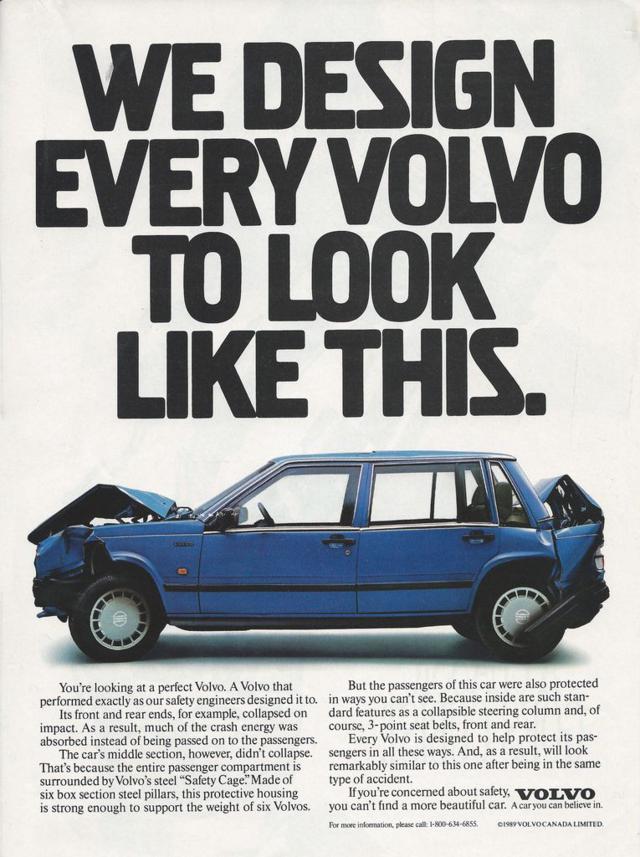
In years gone past, advertising would, at least, try to explain what a product was. At school, I’d occasionally flick through Punch magazine - not because of the unfunny writing, but instead because of the advertising. As seen above, from 1989: in a couple of columns of concise, tightly written copywriting, Volvo would extol the benefit of the “3-point seatbelts” in Volvo cars. It would point out that Volvo invented them, and that the mechanism that Volvo had just released meant that they were even more comfortable, while still allowing the very best safety. I learnt about products and services I might buy in the future, hopefully a future when I wasn’t bored in a school reading old copies of Punch.
Today, that ad would simply be a picture of a car, with a logo. Indeed - look.

So, when I was on the New York Subway, I saw an ad. The copy was a large slogan, using words like: “Don’t let your money go to voicemail. Say hello with Quo”. It’s bright. It’s yellow. There’s no other information. I have no understanding of what this product is.
I point it out to a few people who were travelling with me. “What’s that?” “Probably some kind of crypto thing,” said one. Someone else said it was a bank. We looked it up on the internet. It turns out to be an answering service for your business - so if you’re a plumber, Quo handles your calls while your arm is down a blocked toilet: Quo will book service calls and taking leads, so you can get an Australian plumber to get the camera out, discover it was tree roots all along, and “fire up the jetter”.
Quo is an interesting example, because on researching this blog post, I discover this piece about the ads from a man who rejoices in a job title of “Senior Director of Content and SEO” for the company.
The number we’re projecting is 97 million impressions over four weeks. Our other paid channels, like TV and audio, still account for most of our impressions. That makes OOH an important additional layer, not a replacement for the rest of the paid mix.
That layering only works if the other channels pull their weight. Our ads, email marketing, the website, and sales conversations all have to reinforce the same idea. Otherwise, you’re asking one board to do too much.
So: this isn’t meant to work as a solo ad campaign. It’s meant to amplify the existing ads they apparently run on “TV or audio”. Those ads do the hard work of educating the prospect about the product. This is merely a reminder for people who already know who the product is.
That seems like a massive waste of money, surely? All advertising has a multiplier effect, sure, but why design a campaign so that it relies on hearing or seeing something else first? And remembering it? What happens if they haven’t?
I don’t want to tell advertising people their job, but the right way to market is to make sure that all marketing campaigns work on their own: to make the multiplier effect work much better. Surely?
The company goes on:
Out-of-home has a cruel constraint: nobody is sitting with a coffee and reading your billboard. They’re walking to the train. They’re changing lanes. They’re late for a flight. You get a few seconds, maybe less.
Not on a train. You’re literally stuck on a train. Your eyes are bored and are wandering from ad to ad. You have the opportunity to spend more time with out of home. There would have been no reason you couldn’t have had a two-column, 100-word explainer about the product. If you’re standing next the ad, you could read it. And no requirement to also be spending money with TV or with radio.
Not in a train station. You have three, maybe five, maybe ten, maybe more minutes to stand and wait. Your eyes are looking for something to look at. Some nice copywriting, for example. But no: posters and OOH in train stations are a small slogan and a logo. No detail.
Not, too, on a piece of roadside furniture like a bus shelter or a large poster. Sure, make sure the logo is large, and that the slogan makes sense from far away; but for most, there are human beings walking past these things. For inquisitive people who want to learn more, what’s easier than having some decent copywriting on that poster?
Not in a magazine. Open a magazine these days, and gone are the paragraphs of prose about safety belts. Now, every ad, even in a magazine or a newspaper, is like out of home. It might be a picture of a mobile phone, a logo for it, and if you’re really lucky, a meaningless statement (“Tomorrow, today”). There is no copywriting any more, no crafted sentences telling you why this phone is better than any other. Some may skip blindly past. Others may be interested enough to keep reading. If there’s something there to read. But there won’t be. Just a picture, probably with an aspirational family, of a customer using a product. And you could be that customer too if only you used that product.
A few paragraphs of text can’t make an ad perform any worse, surely? A recall ad like this can only work if people have already consumed the full educational ad. But in an age of declining TV numbers, do we have certainty that this works?
Just look at this ad from a 1986 copy of Smash Hits, selling hifi speakers (the very pair I have on my desk at home):
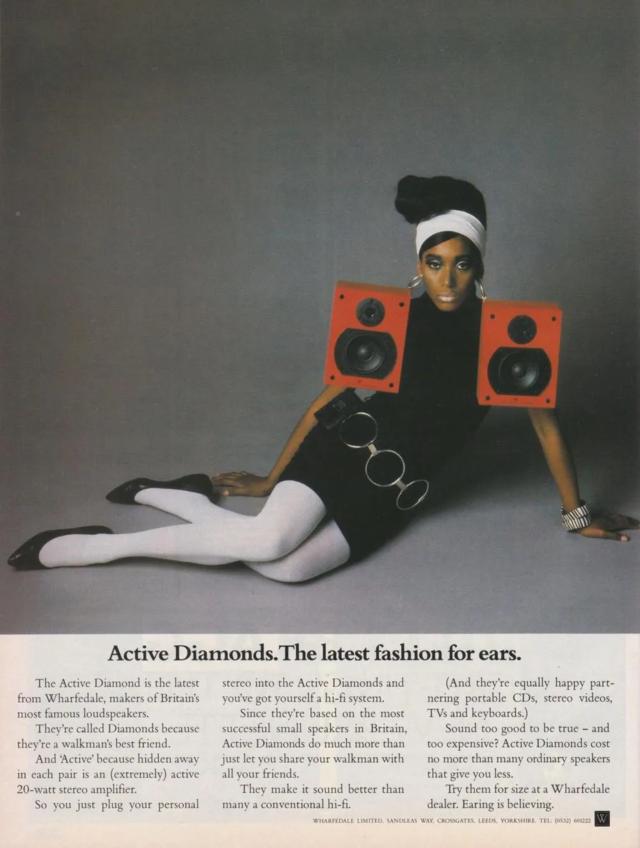
Today, it would simply be the photograph, and no explanation.
Perhaps there are learnings for radio and podcasting here
Radio and podcasting cannot just slap a logo and a picture onto an ad and call it done. It relies on sharp, concise copywriting to work.
But it seems clear to me, looking at ads these days, that there is no copywriting talent needed any more: for there is no copy in any of the other ad formats any more.
So perhaps radio, and other types of audio ads, are seen as more complicated to buy: because there’s nobody left who knows clear and concise copywriting. And the very idea scares them.
What a world!