
The business behind Kyle Sandilands Live - will it work?
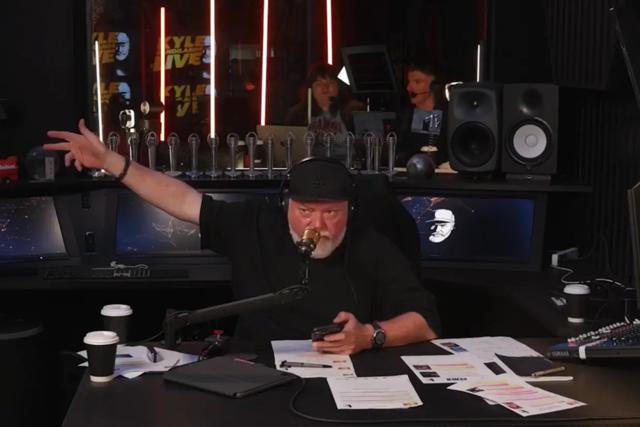
Kyle Sandilands, one half of the Kyle & Jackie O Show, started a radio show on his own streaming app last Monday. The first day was technically rocky, but the second day was rather better, from what I understand. (I’m not a subscriber). Trevor Long posts the audience peak on Tuesday which looks as you’d expect any breakfast show to look. There appears to be a visible viewer-count on some platforms, which has helped him calculate it.
Putting aside the peurile content, I actually really want this to work. Kicking him off FM, but putting him onto a streaming app, was something I suggested a while ago, to derision from much of the industry: oddly, much of the same people who are now championing Kyle’s new “Kyle Sandilands Live” show.
This sort of thing hasn’t worked for any other radio DJ yet - the closest was Howard Stern’s switch to SiriusXM, but it’s not really the same: “KS Live” doesn’t come with another 150 channels: it’s literally just Kyle’s show.
But could it work?
How big could it get?
In an article in Mumbrella, Kyle says he “could get” 20,000 or 30,000 subscribers, and says he has “thousands”. In RadioInfo, he claims he already has “tens of thousands” of subscribers signed-up, has “banked close to $2 million” and claims “we’ve already got the bills paid for the next two and a half years”. Both interviews were published on Jul 28, and I sense some hubris in both. “Once we hit 100,000 subscribers, we’ll start giving cars away every month,” he told RadioInfo.
Calculating the total potential paid audience is difficult. Across all platforms, KIIS in Sydney and Melbourne had 1.1 million listeners each week for breakfast. Before the show finished, Game Changers Radio suggested - I’m guessing from the ratings numbers they had access to - that there are around 300,000 “superfans”, people who only listened to the K&J show. (We shouldn’t forget that not all of those listeners are specifically Kyle fans, but might be Jackie fans, who is not on this show, even if she apparently has a chair specifically kept for her).
So, we start with 300,000 people who are potentially fans; running the typical Patreon numbers of 1-3% suggests KS Live might achieve 9,000 subscriptions. To do more would be exceptional. Hitting 100,000 seems quite high.
The ACMA says that only 8% of Australians listen to streaming radio each week. That might suggest that 24,000 Kyle superfans do. Is that the ceiling for total subscribers?
The cost of subscription will be AUD $99 (US $69) - for a year’s worth of shows. Unlike other subscriptions, there’s no option to pay monthly. That seems a fair chunk for someone that used to listen to the show for free. I wonder about the percentage of Kyle listeners who have access to a discretionary $100, when the same music - if not the same content - is still available for free.
Kyle’s show is commercial-free; but you’d expect that brands would want to be involved with him in some way. That probably means that the $99 subscription won’t be the only revenue generator for this enterprise (and - spoilers - it can’t be).
The cost of streaming for the listener
That $100 annual subscription doesn’t include the cost of streaming data for the listener. Much of Kyle’s audience was listening in a car - which will now need mobile streaming through the app. But - is that going to be prohibitive?
The ACMA tell us that the average data allowance is 69GB for Australians per month; but that the monthly average usage is much lower, at 14.5GB. That suggests that most Aussies could have 50GB or so free that they could use.
KS Live is live streaming video. Data consumption is somewhere like 1.25GB per hour for a 720p video stream. So that probably means listeners could listen to 40 hours a month, or 10 hours a week, or 2 hours a day, without their phone bill growing.
That’s probably good news.
Risks with an annual subscription
It was surprising to see him go with a $99 annual fee, rather than the equivalent $8.99 a month.
Payment cards normally last for three years before they expire. In many cases, an expiring card means that subscription payments simply fail. That would suggest that there’s a risk that a third of all of Kyle’s subscribers could potentially not automatically renew. The process of keeping those customers, known as “dunning” in the industry, is not a simple exercise. But, that’s an issue for the future.
Secondly, it means that Kyle has, essentially, entered into a contract with all these people to do shows for a year. What happens on holidays - especially the six-week Australian summer holiday? What happens when Sandilands is ill, as he frequently was at KIIS? There are no stand-in DJs to do the job for him - yet, at least. A “more music breakfast show” is, for a streamer, actually more expensive than filling it with filthy-talk.
We also have the costs of customer service which aren’t minimal: particularly, avoiding chargebacks (“the app didn’t work”) and similar cost of business.
And what happens when, in March 2027, Kyle is contractually free to be on broadcast radio again? Does he continue to sit in a room broadcasting to a handful of thousand people when he could be potentially reaching millions on broadcast radio?
What are his costs?
Let’s assume he gets 20,000 subscribers.
Live streaming is expensive. He’s using a membership platform called Uscreen, which offers 120 hours of live streaming for a charge of US$11,988/year, plus taking 5% of revenue ($99,000 per year), plus US $0.99 per subscriber per month ($237,000). Live streaming is expensive: he’ll be doing 960 hours of live streaming a year, not just 120: but for ease, let’s assume they only double their price. That makes total Uscreen pricing US $695,976 per year (AUD $933,540). That’s not a small cost. (Actually, that’s half his income).
Someone also needs to pay the credit card payment costs. That’s AUD $1.98 per subscriber, or $39,600 for 20,000 susbcribers.
Then there’s music rights costs. The team have been clear that this product is available globally (with KS Live’s Bruno Bouchet bragging that he’s needed to work out how to pay VAT in Hungary). As we’ve established before in this blog (most notably about the BBC), if you’re earning revenue from a specific country, you need to have music licences for it - and while APRA AMCOS (the writers and performers) has reciprocal deals, the PPCA (the record companies) only covers Australia, so they’ll have to consider music licences in other countries too. There’s a reason why the only truly international online radio station, Apple Music’s suite of channels, are operated by a company that has direct agreements with record companies.
There’s also the cost of potential defamation insurance - which isn’t cheap, but in Australia at least, certainly a requirement for someone like Kyle. And other legal fees - if he’s running competitions for his listeners, who have each paid to be able to listen (and thus to enter), wouldn’t that need a gambling licence?
And those costs get rather worse.
ARN’s settlement with Kyle included ARN getting 19.9% of revenue (after an initial threshold). That’s revenue, not profit. So 20,000 subscribers could mean $400,000 goes back to ARN.
And, Apple/Google will take up to a 30% cut for payments made on the app. So, 20,000 subscribers could actually turn into, worse-case, $1.4mn, not $2mn. (For the MFW to note - Apple and Google is profiting from Kyle’s content, just saying).
$1.4 million for a year is $116,000 a month for the entire business to survive.
Assuming 50% of the business is services cost - the Uscreen product, card charges, music rights, Ubers for staff, the building - then that leaves monthly salaries for eight staff of about $7,000, before tax, per month (or about $5,600 after tax).
Some of the talent Kyle has hired isn’t going to do the work for just above minimum wage, you’d assume: not least because Sydney is not a cheap place to live. Newsreader Brooklyn Ross has worked with Kyle for ten years, Mary Madigan (senior producer); Josh Fox, Pedro Cuccovillo Vitola (Exec Producer), Jaimee ‘Mayo’ Blazquez (guest booker), Alfie Laguzza (producer), Dean Royston (Head of Production), Ella Kanna and Bruno Bouchet (Managing Director) are all reported staff members with a significant pedigree. And, if this piece of Kyle & Jackie O is anything to go by, most commanded a salary of $180,000 or more at ARN.
20,000 subscribers is probably not enough to run this business - let alone “bills paid for the next two and a half years”. I’ve no doubt KS Live has that cash - it’ll either be his, or it’ll be money from investors, who will want their money back.
His potential next steps
Given that it’s unlikely that the maths works with 20,000 subscribers, I’d expect a few things to happen.
First, he’ll need to work with brands who are interested in working with Kyle Sandilands. Given the reputation risk, not everyone will - but the grubbier end of Australian brands won’t care what MFW think. Companies involved in gambling, crypto, alcohol, the sex industry and other things could be a rich seam for Kyle to be involved with.
Second, a weekly compilation video podcast makes sense. This would act as marketing for the show, would be able to earn revenue, and - given the success of the K&J podcast - it could attract a large audience. The market for podcasting is well-understood by advertisers, and there’s opportunity here in an upsell to the full KS Live experiment.
Third, he’ll need to continue marketing this service; for the first time in nineteen years, he doesn’t have free advertising on the radio. I’m surprised that there aren’t clips on YouTube, or on Instagram - you’d assume that they would make sense to highlight what you’re missing. (As of now, it turns out that there are a few clips from KS Live - “I was fooled into promoting the COVID vaccine” or Australian women are “undateable”. Eurgh.) The media interest will wane. We do know there is some marketing money from ARN, but presumably that’s marketing money on ARN properties in such a way that doesn’t anger MFW.
The future for live radio could be online - though we’ve never seen it in reality (with DAB+ in Australia still bigger than streaming radio).
Kyle has the capability to make paid online radio work. I hope he can. But I hope he, or Bruno, are open and honest if they can’t.
Further reading
- Irene Hulme has posted more detail on the groups of people that might subscribe; and suggests that 16.6% of annual subscriptions churn at the first anniversary.