
Does a trademark application tell us anything about Global's plans?
This is Radioland, my radio trends newsletter.
Back in mid-November I covered SCA’s lacklustre “Heart” here in Australia, jokingly saying “if you’re expecting to be able to turn up the feel good and enjoy a version of the vibrant Heart from the UK, then you’ll be disappointed”.
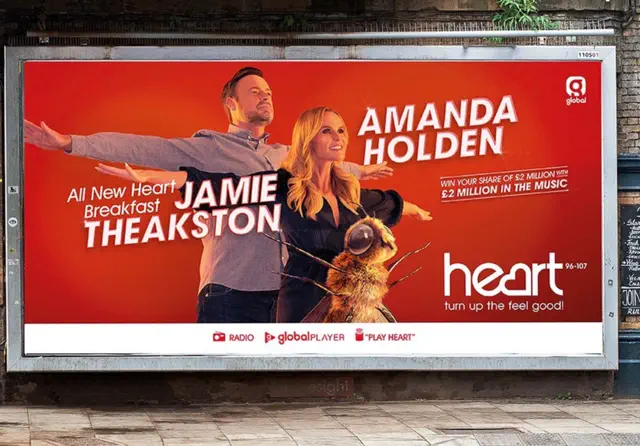
Well, it appears that Global in the UK, which owns Heart - the biggest radio brand in the country - has noticed. A search of IP Australia for registered trademark applications reveals that an Australian trademark application for Heart was made by Global on Oct 31 2025, just three days after SCA launched its own Heart.
Global has also filed a “removal of registration for non-use” against SCA, who used to own “Heart 107.3” in Hobart - but that changed name in 2006.
Global also applied for The News Agents as an Australian trademark in 2023 - a year after the launch of its daily news podcast. And the company already owns a few trademarks here in Australia - “Global” itself; “Global ID”, the user registration tool; “Global’s News Room”, the name of the company’s newsgathering services; and… oh, “turn up the feel good”, Heart’s positioning statement, registered in Sep 2021.
I’ve often joked that “Global isn’t, really” - it only owns radio stations in the UK (and, now, Monaco). But, these trademark applications show that it appears to be interested in radio overseas, and I suspect it’s just biding its time.
In 2020, the FCC allowed iHeartMedia to be 100% foreign-owned; the Bahamas-based Global Media & Entertainment Investments Ltd currently owns 14% of iHeartMedia in the US. RadioToday reported recently a request to the FCC from iHeartMedia to transfer Global Media & Entertainment Investments Ltd’s shares to the UK-based Global Media Investments Limited.
But perhaps Global isn’t just interested in the US. Australia has many parallels to the UK - two big radio groups, opportunities with DAB+, a strong public service broadcaster. And no specific rules against foreign ownership. Maybe Global is waiting for an Australian radio group to fall on bad times - a low share price, low confidence in management, and current owners willing to sell.
By complete coincidence…
NewsCorp sold its shares in ARN this week. ARN is the rather embattled owner of KIIS and Gold in Australia, which is currently warning of significantly lower profits. NewsCorp had owned those shares for a decade, having increased its holding to 14.99% in March 2015 at 88¢ a share. NewsCorp gets $18mn - and loses $18mn, since it sold its stake in ARN for 44¢ a share. The current market cap of ARN is $140mn; Sydney smut-peddlers Kyle & Jackie O have just completed the first two years of a ten year deal: at $200mn, a deal worth more than the worth of the entire company.
Oh - and ARN has a brand licence for iHeartMedia’s “iHeartRadio” and “iHeartPodcasts” brands in this country, as well as the app. Handy.

Classifieds
- Supercharge your radio show with world-class prep: the right show prep delivered to you on time, EVERY day, without fail. Grab a £1 week-long trial of Show Prep and stop chasing round looking for things to use on your show, running out of time before the show, and trying to sight-read the newspapers!
How should you use AI within radio? The article I’m linking to here isn’t about radio, but it might as well be - Gordon Firemark, a media lawyer in the US, has been thinking long and hard about how to use AI within podcasting, and it’s all relevant for radio as well. One takeaway: you can’t copyright anything that was produced by AI, so if you make a logo using it, and someone else nicks it, then… tough. A fascinating read.
An Audio Advent Calendar! With a different sound behind each door.
YouTube’s algorithm appears to have changed in September: it now heavily favours recency, according to Mario Joos on LinkedIn - who shares a way you can isolate the data for yourself. If there’s one thing that radio benefits from, it’s recency. Unlike most other media, we’re producing new stuff every single day - so, particularly with YouTube shorts, we should benefit from this.
College Radio Keeps Its Cool - ‘but if soon after the late summer of 1991 the internet killed radio, everyone forgot to tell the student stations’ (a unlocked story at The New York Times)
In Australia, CRA reports that Q3/2025 saw broadcast radio revenue down aound 5% year-on-year. Digital audio revenue is up 12.1%, but it’s just 9.7% of total revenue for the country’s radio broadcasters (for iHeart in the US, it’s 14%). Additionally, CRA members only represent a third of the digital audio ad market. (You’d assume they represent around 95% of the radio ad market).
Spotify’s Wrapped, and Apple, YouTube and Amazon equivalents, all dropped this week. I’m curious - has any radio station run the equivalent? (We played XX,XXX songs; Sabrina Carpenter was #1; the most popular time to listen is 8.43am; etc) - seems like it’s an obvious no-brainer to highlight the significant size of radio broadcasting, and reaffirm some marketing messages. I’d love to cover something like that.
Many breakfast shows in the Brisbane market have packed up early, with another week of survey still to go. NOVA (two out of the three hosts finished up last Friday, as Mister Brisbane reports); 4BC (where their breakfast announcer disappeared in mid October); and KIIS (where a well-respected trio ended a few weeks ago - and where Craig “Lowie” Low is apparently doing a new show from mid January, though I’m still hedging some bets that all isn’t as it seems). The last survey this year ends on Friday; and will report (for the period Oct 5 - Dec 13) on Jan 20.
Where I am speaking next
Podfest, Orlando FL, USA (Jan 15-18, 2026) Where we’ve been - and where we’re going: A look back at where we’ve come from, including last year’s podcast news and trends, to help us understand how podcasting is changing and how we should be changing with it. Plus, a look forward to what to do in 2026.
Radiodays Europe, Riga, Latvia, (Mar 22-24, 2026) The future of audio is people-powered: The way people consume media is changing. James Cridland, the radio futurologist, takes a look at global trends in radio and on-demand. How will we listen - on which devices? How can we make our output truly unique? How do we do it in a resource-efficient way? And what part does video play in the future of audio? In this wide-ranging session, bringing together data from North America, Asia, Australia and Europe, we’ll learn why the future is bright - as long as we understand why our audience comes to us in the first place.
Supporters
Thank you to the supporters below, plus Greg Strassell, Sam Phelps, Richard Hilton, Emma Gibbs, Jocelyn Abbey and James Masterton for being regular supporters.
If you’d like to support my work in any way, you can BuyMeACoffee - become a member to give regularly or just give a one-off coffee, or five. Here’s where to do that. Or, alternately, here’s a way direct with Stripe.
I’m on Bluesky as @james.crid.land or on Mastodon as @james@bne.social - tip, use the second one.
My website has more detail about who I am, and what I do, and whether I can help you further.
My newsletter is supported by:
Selected bits from Radioland are in RadioInfo in Australia, and RAIN News in the US
Lesen Sie außerdem ausgewählte Artikel auf Deutsch in Radioszene