The stupid bit of Australia’s social media ban for kids

Governments everywhere are not very good at technology, but the Australian government excels in almost deliberately not understanding it.
In 2017, Australia had a Prime Minister called Malcolm Turnbull. All indications were that this was a man who knew his stuff.
As a lawyer, Turnbull had successfully defended Peter Wright, a former MI5 official who wrote Spycatcher - leading to the book being published in Australia. Then, Turnbull bought a $500,000 stake in the Australian ISP OzEmail, selling it just before the dot-com bubble burst for $57mn. So, a man who understood freedom of speech, and a man who understood the internet.
Sadly, two-brains Turnbull went on to attempt to pass a law to force tech companies to give a backdoor for encrypted messages to the government. Encryption can’t be weakened for just one set of people - the laws of mathematics are that if you weaken encryption to let the government in, you also weaken encryption for the rest of us: breaking online banking and payments, as well as chats.
“The laws of mathematics are very commendable, but the only law that applies in Australia is the law of Australia,” said Turnbull, in the sort of smug logic-twisting nonsense that was to prove his downfall twelve months later (yay!) when we got Scott Morrison instead (oh).
Turnbull isn’t alone; and this week sees Australia enact a ban on social media for children under 16.
The law forces social media companies to stop allowing under-16s from holding an account on their platforms. Which is good, I think.
What the law doesn’t stop
The law doesn’t make it illegal for kids to access them. The only people who’ll get fined are the social media companies.
Further, the law lets kids access the social media websites anyway. They just can’t hold an account.
(So, use of a VPN makes no real difference - it won’t be illegal to use one to access social media; but if companies let someone from Australia use social media through a foreign VPN, they will be fined).
And, the law doesn’t stop many “social media companies” at all. Someone who is under 16 can pop along to Murdoch’s Courier-Mail’s website, open an account and leave an angry comment, and that’s absolutely fine. Instead, companies have to be named by the government. There are only ten companies actually named - like Facebook, and Instagram, and Reddit, and Twitch.
I’m fine with these companies being banned for under 16, actually.
But
Another company named by the Australian government under this law is… YouTube.
The stupidity of YouTube being on this list
YouTube isn’t a social media platform. It’s a video service.
There are comments on YouTube; but as we’ve established above, there are comments on the Courier-Mail website too, and they’re not banned.
Being the parent of a daughter under the age of 16, I’m more aware than most about the protections YouTube has in place. I can ensure that she is forced to use “safe-search”, which is supposed to successfully stop her from unearthing bad things. I can also ensure that if she does find bad things, she can’t play them. Google’s Family Link is pretty good software, all things considered.
She’ll still be able to use YouTube. The law doesn’t stop that. She just can’t use YouTube with her account. Which means she gets, potentially, the worst of YouTube, and I can’t do a thing about it.
Her account is a premium account, so I pay to get rid of the advertising when she uses YouTube. Except the Australian government, in its brilliance, won’t let my daughter use YouTube under her premium account, so she will have to see all the advertising.
YouTube won’t know she’s under 16. She could opt out of seeing gambling-related ads on YouTube - but to do that, she’d need to log in, which would mean she’d have a YouTube account, which she isn’t allowed. The same goes for ads for alcohol.
And she can’t use YouTube Music. If you’re unaware, YouTube Music is a bit like Spotify. Well, very much like Spotify. It’s got every song in it, and you can listen to all the songs. Just like Spotify. But I can’t let her use YouTube Music any more, because that requires access to the account that she can’t have access to.
So, stupidly…
Under this law,
- My daughter can still use YouTube and access videos on it.
- I can no longer control what she sees on the service.
- I can no longer get rid of the advertising there.
- I can’t even control what ads she sees (and nor can she).
- She no longer gets access to YouTube Music either.
For music, we’ve had to shift to Spotify, which offers an identical service, but which isn’t apparently a social network, even though she can look up her friends on there. And message them.
And I’ve retained YouTube Premium for my use (so I don’t see the ads), so I’m now paying for two music services, not one.
None of this makes much sense to me.
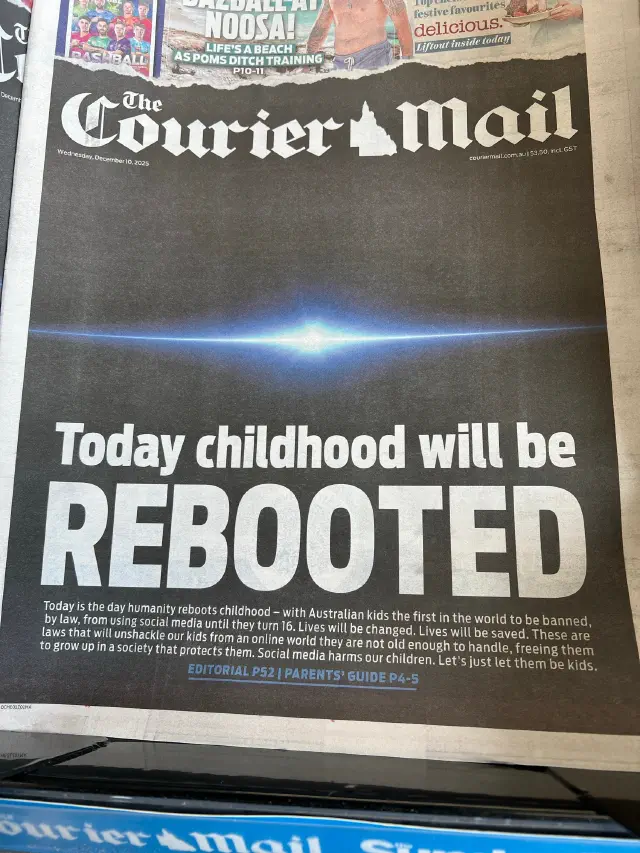
Although perhaps the front page of the Courier-Mail makes it a little more obvious that Murdoch thinks this is a very good idea indeed.